



Juniata College
Huntingdon, PA
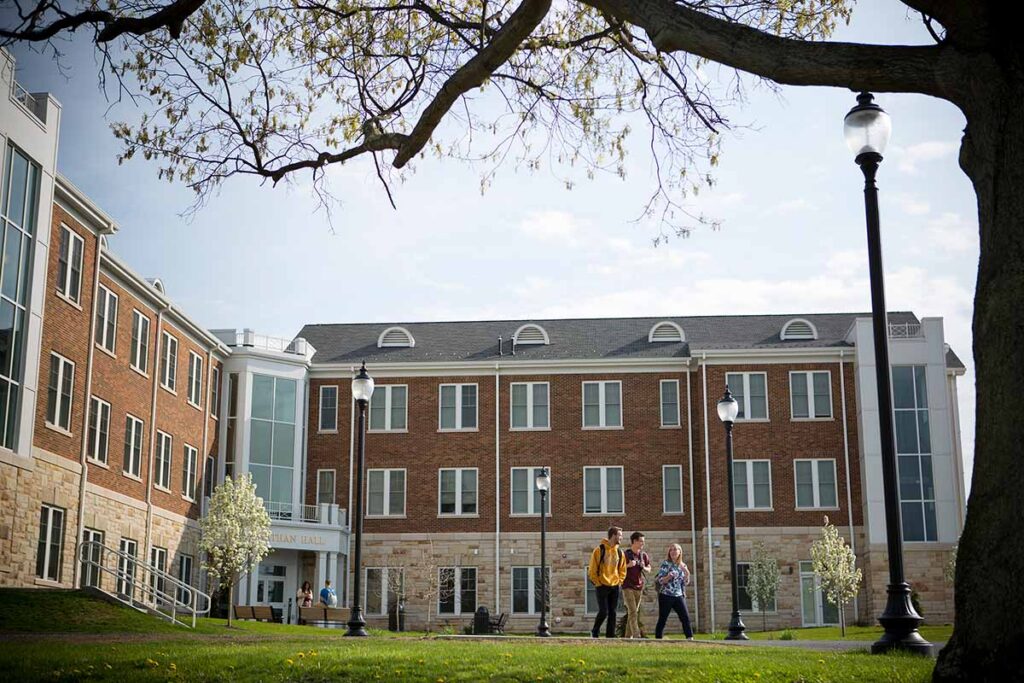
Nestled in central Pennsylvania’s rolling hills, Juniata College has spent 150 years perfecting a liberal arts model that puts students in the driver’s seat. Its over 1,200 undergraduates craft individualized Programs of Emphasis, interdisciplinary majors co-designed with faculty, from 3,648 possible combinations. Every graduate completes a global engagement requirement, reflecting Juniata’s conviction that true learning crosses borders. The college welcomes students from 36 countries and sends 200 outbound annually, often through faculty-led programs that blend academic rigor with cultural immersion.
Jamie Weaver, Dean of International Education, leads this work with a lean team of three full-time staff and one part-time colleague. When Weaver arrived four years ago, Terra Dotta Study Abroad was already in place but underutilized and ripe for transformation. Drawing on her prior experience using the platform daily, Weaver turned scattered processes into streamlined workflows, proving small teams can achieve outsized impact.
Weaver’s first year focused on understanding what did and didn’t work. Predecessors hadn’t standardized program templates or completed the admin console migration, a transition she’d experienced at her previous institution.
Paper processes lingered for health forms and scholarship applications. Faculty-led programs lacked formal proposals, leaving the office blind to itineraries, budgets, or learning outcomes.
“I spent that first year overhauling Terra Dotta,” Weaver recalls. Step one was auditing every workflow: advising, applications, and backend processing. Coming from a major university with thousands of students studying abroad, Weaver knew standardized operating procedures made the difference. Post-COVID, as the sole full-time staffer reporting to an interim dean, Weaver had the freedom to act fast.
of annual scholarship funds awarded (up from ~33%)
paper workflows for health forms, proposals, and scholarship applications
to launch a new faculty-led program

academic path combinations
student clubs and organizations
academic advisors per student
One of the early wins was the most straightforward: getting sensitive student health information out of physical packets and into a digital, permission-controlled system.
Previously, faculty leading programs abroad received sealed paper packets containing students’ protected health information, such as vaccination records, medical histories, and more. They were responsible for keeping those documents secure while traveling. It was an awkward burden for people who hadn’t asked for it.
“Faculty were incredibly relieved to step away from that responsibility,” Weaver notes. Now, students complete a health questionnaire directly in Terra Dotta, their information lives centrally in their profile, and faculty receive only what they need, shared securely through a permission-based report.
This transition not only strengthened data security but also removed a logistical friction point that had made faculty hesitant about leading programs in the first place.
Perhaps the most striking opportunity Weaver discovered upon arriving at Juniata was one that, on the surface, looked like a student behavior problem. In reality, it was a process design problem.
Juniata awards between $100,000 and $120,000 in scholarships annually, most of them endowed funds. But the office had been awarding only about one-third of that money. Students weren’t applying, not because they weren’t eligible, but because applying meant completing yet another essay on top of everything else required for study abroad.
“My predecessor would have to beg students to apply for these scholarships,” Weaver says. “A lot of their time was dedicated to convincing students to complete yet another essay or yet another step.”
Weaver collapsed five or six separate scholarship essay applications into a single 10-question questionnaire, embedded it directly into the study abroad application, and made it required. The questionnaire captures where students are studying, why they chose that destination, and whether they belong to any communities for which specific scholarships are designated.
Eligibility is now determined automatically based on responses, so the office no longer has to chase anyone. Now, Weaver and her assistant can sit down together and complete the full scholarship review and award process in a matter of hours.
“We can pull the report knowing that everybody has filled it out,” Weaver says. “Pull the report, divide up how much money we have, decide how we award, and be done with it.” Today, the office spends down to approximately 98% of available scholarship funds thanks to the redesigned process.
The scholarship overhaul was part of a broader effort to eliminate redundancy throughout the student experience. Before Weaver’s arrival, students navigating the study abroad process were asked to complete multiple separate questionnaires, each requesting variations of the same information.
“They had a lot of different questionnaires that I merged into one,” Weaver explains. “I cut down on the need for a variety of information because they were asking for things that I could easily pull from the profile of the student.”
The result is a single, comprehensive study abroad questionnaire that consolidates what had been three or four separate essay prompts, capturing the full picture of a student’s goals, background, and eligibility in one place. For staff reviewing applications, the time savings compound across every applicant.
As Juniata’s faculty-led program portfolio grew, so did the need for a more structured way to plan, approve, and track those experiences. Weaver saw an opportunity to introduce a formal proposal process that would give faculty a clear roadmap, provide the provost with the visibility needed to confidently approve programs, and present the office with a reliable record of every program in its history.
Weaver built a full faculty-led program-proposal workflow in Terra Dotta. A year before a program is planned, faculty submit their proposed learning outcomes, health and safety considerations, partner details on the ground, a draft itinerary, and a preliminary budget. Once the deadline passes, Weaver downloads a consolidated report and shares it with the provost for review and approval.




“The proposal process goes directly through Terra Dotta,” Weaver says. “And that includes questions about where you are going, who is your co-leader, when do you plan to go, what are your learning outcomes, what’s your health and safety plan, are there any natural disasters or risks we should be aware of.”
The benefits extend beyond compliance. The workflow has also given Weaver a persistent, searchable record of every program that has ever run: who led it, when it ran, the outcomes, and how many students participated.
Repeat programs, courses that run every year or every other year, don’t need to be rebuilt from scratch. Weaver simply toggles them active or inactive and updates the application cycle. For new programs, Weaver works from a baseline template, filling in the specifics, and can stand up a program in about half an hour. “I’ve been using the software for 10 years at this point. I have it all built: get a new program, build it in, pull the information from the proposal the faculty has already given me, put the budget in, done.”
Faculty who aren’t leading programs but are traveling internationally are also required to register travel through Terra Dotta—another way the platform extends beyond student-facing services and into institutional risk awareness.
The operational foundation Weaver built doesn’t just support efficiency but also enables innovation. That’s evident in the work of Juniata’s faculty, including a recent recognition from the Forum on Education Abroad.
Faculty members Amy Frazier-Yoder and Matthew Beaky received the 2026 Award for Excellence in Education Abroad Curriculum Design for their course Chile: Southern Stars.
The program blends astronomy, cultural history, and Indigenous knowledge systems, offering students a deeply interdisciplinary learning experience.
This kind of program reflects Juniata’s broader philosophy: global education as a space for inquiry, connection, and impact. It also reflects the infrastructure behind it. With structured proposal workflows, centralized data, and streamlined program management, faculty can focus on what they do best: designing transformative academic experiences.
Weaver’s advice for international education leaders considering a similar overhaul is grounded in something she hears echoed across the field: institutions underestimate the true cost of inefficiency.
“I was talking with a coworker on campus about weighing the cost versus the time and the energy dedicated to completing administrative tasks,” Weaver says. “If the cost of a software is less than the time, energy, and other resources that you have your staff members working on, the choice becomes clear.”
That reframing from “is this software worth the cost?” to “what is the manual alternative actually costing us?” is something more leaders should make. Learning curves are real, Weaver acknowledges, but they’re not the reason to stay stuck.
“I think it’s something you can embrace and use to build other aspects of the office up,” Weaver says. “Coming here, I saw a lot of opportunities. Why are you still collecting that on paper? Why is that a manual process when it doesn’t need to be? Trying to take a step back, look at those things, and then really putting a dollar on the time and the energy of your staff members versus the software—that’s a great way to go forward.”
For a small office doing the work of a much larger one, that philosophy is both practical and essential.

If the cost of a software is less than the time, energy, and other resources that you have your staff members working on, the choice becomes clear.

As Juniata looks ahead, the focus is on deeper integration, connecting study abroad, international student services, and institutional data into a more unified ecosystem. Planned enhancements, including course equivalency workflows and expanded reporting capabilities, will further streamline operations and strengthen insights.
But the most important shift has already happened. By transforming fragmented processes into a cohesive system, Juniata has created a foundation that supports both scale and personalization, proving that even small teams can deliver global impact when equipped with the right tools and a clear vision.