


James Madison University
Harrisonburg, VA
Founded in 1908, James Madison University (JMU) is a public university in Virginia’s Shenandoah Valley, recognized as one of the nation’s leading lights in higher education. With more than 22,000 students across over 130 programs of study, JMU is defined by its commitment to unusually engaged student-faculty relationships.
The university’s Center for Global Engagement (CGE) reflects that same commitment to accessible, high-quality education, offering 158 study abroad opportunities in 50 locations around the world. From faculty-led programs to semester exchanges and global virtual experiences, the CGE provides a full range of opportunities designed to make global education achievable for every student.
As participation expanded and operational needs evolved, the office recognized an opportunity to modernize how study abroad programs were managed and supported.
Before transforming their operations, JMU’s study abroad office relied on paper application forms and three separate Access databases to manage student records, program information, and operational workflows. Data was scattered, backups were labor-intensive, and generating reports or responding to stakeholder requests often required significant manual effort.
automated profile updates through integrated Student Administration and HR systems
application processing time via automated workflows and the reviewer console
data accuracy for tuition, fees, and cross-campus collaboration

study abroad opportunities
active programs in use
locations around the world
“Our processes were highly manual and reactive,” explains Angeline McMullin, Associate Director of Programs at the CGE. “Application tracking, student communications, and reporting demanded significant staff time and often depended on temporary workarounds.”
For a small team committed to providing high-touch student support, the operational burden was real. Staff could support students, but they were stretched thin, balancing personalized service with growing demand and limited visibility into program trends or bottlenecks.
University audits eventually flagged limitations in the Access database structure, citing the growing volume of study abroad applications and operational risks. The directive was clear: transition to an enterprise-level system that could scale with institutional needs, support secure data management, and pro
Rather than attempting a full-scale transformation overnight, JMU took an incremental approach focused on high-impact improvements. The first priority was replacing the three Access databases with Terra Dotta’s centralized platform and integrating it with the university’s core systems.
The team worked to connect Terra Dotta with JMU’s Student Administration and HR systems, enabling student and faculty profiles to refresh automatically within 24 hours. They also integrated with CashNet to streamline application fee collection, helping offset system maintenance costs while simplifying the student experience.
With the technical foundation in place, the office turned its attention to standardizing workflows, improving data integrity, and automating repetitive tasks. This meant cleaning and standardizing application statuses, creating consistent student groups organized by term and program type, and streamlining reviewer workflows so that faculty and staff could manage applications more efficiently.
“As a small team, we implemented many of these changes independently,” says Agnes Choi, Study Abroad Enrollment Manager at the CGE. “We mapped files to support system integration, cleaned up application statuses, and improved communication templates.”
Where the team needed additional expertise—optimizing deployment rules, refining reporting capabilities, or troubleshooting complex workflow configurations—they turned to Dottan Desk for support. “This partnership allowed us to extend our capacity and configure a highly organized and efficient system,” adds Choi.
One of the most significant outcomes of the transformation was the role analytics began to play in decision-making. With data centralized and reporting tools in place, the office could finally see patterns, track trends, and identify opportunities that had been invisible before.
“Analytics became a cornerstone of our decision-making,” says McMullin. “By improving data structure and reporting, we were able to track participation trends across terms and programs, identify bottlenecks in the application and commitment stages, and provide timely data to program directors, on-site staff, Financial Aid, the Registrar, and leadership.”
Instead of responding to issues as they arose, the office could anticipate needs, allocate resources strategically, and support students more proactively. Automated reminders helped monitor and support students’ completion of requirements. Real-time insights informed conversations with campus partners. Historical data guided long-term program development.
“Data has shifted our approach from reactive to proactive,” McMullin notes. “With the enhanced capabilities of the analytics tools, we can now support strategic planning with both historical and real-time insights. For a small office managing hundreds of students across more than 130 programs, that shift was transformative.”

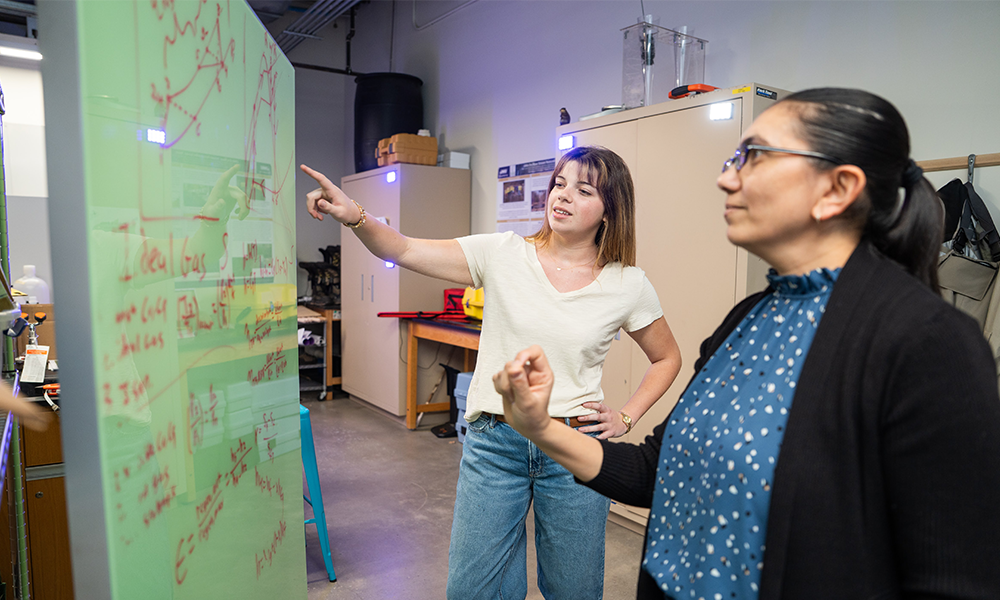


The changes didn’t just deliver tangible results for staff, but also for students, faculty, and campus partners.
Application processing became faster and more accurate. The implementation of Application Triggers and the Reviewer Console, with reviewer roles configured by program group, reduced the time required to move students through the application cycle. Faculty program directors gained clearer access to their applicant lists, making it easier to stay engaged with their cohorts.
Tuition and program fee coordination improved significantly. With reliable data flowing between systems, the office could ensure accurate billing and reduce administrative friction for students navigating financial logistics.
Communication became clearer and more consistent. Standardized templates and automated touchpoints meant students received timely guidance at every stage, and faculty had the information they needed to support their programs effectively.
Compliance strengthened across the board. The new system aligned with JMU IT’s annual system management policies and procedures, addressing the audit concerns that had initially prompted the transition.
“Most importantly, these improvements allowed us to support more students efficiently while reducing overall workload,” says Choi.
As the office’s use of analytics matured, the team began building live dashboards directly on Terra Dotta’s data, reducing the need to export to Excel for every report. Salman Sheikh of the CGE worked with Terra Dotta’s product team to stand up new dashboards connected to live application data.
Using grouping and filtering, the office can now calculate conversion rates, such as the share of applications that move from created to committed, directly within dashboards rather than rebuilding the calculation in a spreadsheet each time.
“Dashboards are intuitive and easy to navigate. The hover-over details mean I don’t have to dig around to find what I need, which cuts down on steps,” says Sheikh.
The team also tackled one of its toughest data challenges–programs with irregular or off-cycle application deadlines, including faculty-led new-dukes short term programs in Germany and Guatemala. Sheikh developed logic to assign application cycles and statuses for these programs, a step that is helping the team rely less on manual Excel work and more on the dashboard for day-to-day reporting. “It’s saving me time I used to spend in Excel pivots,” adds Sheikh. “What used to take a nested formula now happens automatically in dashboards.”
With a stable, data-rich foundation now in place, JMU’s study abroad office continues to refine and expand its use of Terra Dotta to support evolving institutional priorities.
The team is exploring expanded use of analytics for equity and access initiatives, ensuring that study abroad opportunities reach students from all backgrounds. They’re working on enhanced automation for commitment and compliance tracking, further reducing manual effort while improving oversight. And they’re pursuing deeper integration with campus systems to support continued program growth.
“Our long-term goal is to create a more accessible, transparent, and student-centered global experience,” says McMullin. “We’re working to optimize internal workflows, reduce administrative barriers, and draw on data to improve equity, participation, and program sustainability. Ultimately, we want every student to see study abroad as achievable and well-supported.”
From paper forms and scattered databases to a centralized, analytics-driven operation, JMU’s journey demonstrates how the right systems, paired with thoughtful implementation and institutional partnership, can streamline workflows and enhance processes.