
Clark University
Worcester, MA
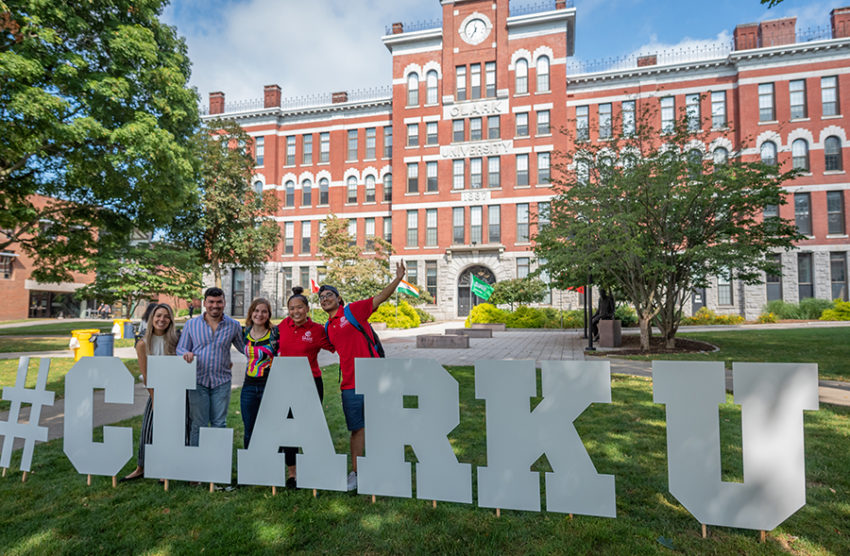
Clark University, a pioneering research institution in Worcester, Massachusetts, has long been a place where bold thinkers challenge convention. From hosting Sigmund Freud’s only U.S. lectures to its current status as a “Best Value” school, Clark balances rigorous research with a deeply personalized student experience.
This commitment to excellence is mirrored in its International Students and Scholars Office (ISSO), where a lean, high-performing team of three manages the complex needs of over 1,900 international individuals. To maintain their high standards of support while increasing operational resilience, Clark became the first higher education institution to go live with Terra Dotta’s ISSS Next Gen scholar module.
Clark was already a Terra Dotta customer before this story begins. The transition from Terra Dotta Classic to ISSS, as Amanda Desai, Director of the ISSO, described it, had been a positive one and helped shape her expectations for what technology should enable. On the scholar side, however, the experience had not kept pace.
The legacy scholar module functioned primarily as a document repository rather than a fully integrated workflow system. While records were stored in the platform, most day-to-day interactions with scholars, such as travel signature requests, DS-2019 reprints, and incidental employment questions, took place outside the system, primarily over email. As a result, processes were not centralized, and communication often required additional coordination and follow-up.
There was also a broader operational impact. Processing a single DS-2019 involved multiple steps across systems, including reviewing information, entering data manually, and managing follow-up communication, which could take up to 30 minutes per case. At the leadership level, reporting capabilities provided less visibility, slowing planning and resource allocation.
reduction in per-scholar DS-2019 processing time
service disruptions when team members are out of the office
RTI downloads and structured data entry
study abroad and away programs in 34 countries
majors, minors, and concentrations
student clubs and organizations
When Terra Dotta offered Clark the opportunity to become an early adopter of the ISSS Next Gen platform, Desai didn’t hesitate. Her reasoning was straightforward: she had already led Clark through the Classic-to-ISSS transition and trusted the direction the platform was heading. The new version promised exactly what the old one lacked—a real hub for scholar requests, structured workflows, secure document handling, and the ability for multiple team members to manage the queue.
“Why wouldn’t you want the utmost up-to-date, newest system for your scholars and for your department?” Desai says. “To me, it was a no-brainer.” She reviewed the decision and found very little downside. The new scholar portal required essentially no involvement from the IT department, which removed a significant internal obstacle. Clark’s scholar population is small enough that the risk of early adoption felt manageable. And there was a secondary benefit she found equally compelling: the scholar rollout would give her office a preview of the student-side upgrade ahead, letting the team build confidence before taking on the larger transition.
Justin Balcourt, Assistant Director, supported Desai’s perspective. “I didn’t really see any point in holding on to one iteration of a system when a new iteration is coming out, and there’s an opportunity to jump on it,” Balcourt adds. “You get to see a lot more behind the scenes when you’re one of the first adopters.”
Balcourt led the technical buildout of the implementation alongside the Terra Dotta team, despite having a limited tech background. “Database management was not something I’ve ever done so in depth in a previous role,” Balcourt notes. Despite that, he configured the request structure, worked through the document importing process for existing scholars, and set up the system architecture. His assessment of why it worked: the interface was intuitive enough that someone without a technical background could figure it out and keep moving.
Desai joined one meeting midway through implementation and had a similar experience. “Within a few clicks, I figured out how to use the software,” she says. “It was very easy to figure out, even if you don’t consider yourself tech savvy.“
What made the difference, both said, was the Terra Dotta team’s domain knowledge. The implementation leads brought significant DSO (Designated School Official) backgrounds to the work, and that showed. “It helped that the team had clearly significant backgrounds as DSOs themselves,” Balcourt explains, “because they knew beforehand going in what we were going to be asking of them.” Rather than just walking through technical steps, the Terra Dotta team offered real-time workflow guidance during request buildout: here’s how other institutions have handled this, here’s why this approach tends to work better with RTI, and here’s what to watch for.
The project plan itself was detailed and transparent: a clear schedule with tasks, owners, and timelines that gave Clark visibility throughout. The team also moved quickly when questions arose. “The implementation team was extremely helpful and fast with any questions or issues that arose,” Desai notes.
The rollout itself landed approximately one week off the original target, a gap Balcourt attributes entirely to ordinary scheduling: a vacation here, a sick day there.
The changes Clark experienced after going live were practical, immediate, and meaningful for a small team.
The most significant shift was operational resilience. Previously, every request had been routed through Desai’s email. Now, the full request queue is visible to any team member who logs in. Clark has since cross-trained Balcourt and the third advisor as Alternate Responsible Officers (AROs), further distributing the workload. “We don’t need to stop operations when somebody is out of the office,” Desai says. “That is the biggest win.” For a three-person team serving an institution where immigration compliance doesn’t pause for vacations, the value of that change is hard to overstate.


Processing time dropped measurably as well. A single DS-2019 that used to take approximately 30 minutes after reviewing all the needed information—from reading the email, to manually entering data, to managing follow-up correspondence- now takes 15 minutes because scholar information arrives structured and ready to act on through the portal. “It definitely saves me time in my day-to-day work,” Desai says. With e-signature functionality on the horizon, she projects the timeline will drop to approximately 10 minutes end-to-end. Balcourt echoed the same figure independently: “It cuts off about 50% of the work when it’s all in one place.“
Document security improved in a way that had been a persistent concern. Scholars now upload sensitive immigration documents directly through the portal. “The data integrity and security of scholars’ documents has significantly improved,” Desai notes. RTI (Real-Time Interface) interactions also became meaningfully faster in the new system. Clark uses RTI rather than batch processing for its scholar population, and the speed improvement has turned what was once a time-consuming task into a quick, routine one. “RTI downloads are much easier and exponentially faster than the previous software iteration,” Desai says.
Reporting, too, has become a more functional tool for the office. Desai relies on reports to forecast advising resources: identifying, for example, how many May graduates will be STEM OPT-eligible the following year so she can plan workshops and staffing accordingly. The upcoming AI reporting feature, which Balcourt saw previewed at the Terra Dotta conference, could go further. “That for us would be game-changing,” Balcourt says.
Clark’s scholar portal is now what Desai envisioned from the beginning: a one-stop solution hub rather than a repository for records. The shift from “email your ISSO advisor” to “go to the portal” is the central workflow change for the scholar community, and it reflects a broader philosophy that the office has been working to establish for years.
“From day one, when they step boots on the ground in the United States, we tell them: get familiar with the ISSO portal. This is your hub for all your immigration needs,” Desai says. That message, extended now to scholars as well as students, is backed by a system that can actually deliver on it.


Clark is also preparing to become one of the first institutions to implement the student-side ISSS Next Gen upgrade, with a target of full rollout by fall 2026. Balcourt, having navigated the scholar implementation, is already confident about what’s ahead. “I can already tell it’s going to be pretty smooth,” he says. Desai’s summary of the experience so far captures the office’s momentum well: “We got what we wanted and more. Now that we know what this can do, what problems can we solve with this solution?”
For ISSO teams considering a similar upgrade, Desai and Balcourt offer practical, experience-grounded advice.
Start by auditing what currently lives in email or homegrown workarounds, and ask what should live in the system instead. The implementation process is also an opportunity to rethink workflows, not just to replicate what existed before, but to build something better. “Use this opportunity to build your dream scholar portal. What do you want your scholars to experience? What do you want your academic team to experience? There’s not much I found that we can’t do,” Desai notes.
Actively lean on the Terra Dotta team’s expertise during implementation. Balcourt describes how real-time guidance from the implementation leads shaped the request structure in ways that saved significant rework. “Having that immediate feedback was really helpful, considering we were just building out requests kind of blindly at the beginning,” Balcourt says.
Invest in change management because good software still requires people to use it. Desai is building a communication plan that includes how-to guides, drop-in hours, and workshops for the faculty and staff who will interact with the system as academic sponsors and department contacts. “Sometimes people can be resistant to change, so I would recommend marketing the benefits of the change to your campus stakeholders,” Desai notes. The goal isn’t just to train users on functionality; it’s to shift the default behavior so that the ISSO portal becomes the first stop.
Desai’s advice for offices still hesitant about early adoption: the risk is lower than it looks. “The benefits outweigh efforts 1,000%,” Desai emphasizes.
There are still improvements on the horizon. Features such as e-signatures promise to reduce processing time further. AI-driven reporting could transform how the office generates insights. A more mobile-friendly experience would meet users where they are. But the foundation is already in place.
By embracing technology early, Clark University has not only modernized its workflows but has also protected its core mission: providing high-touch, personalized advising that helps international scholars and students thrive.